28.04.2005
GE Advanced Materials, Automobilbau, beschleunigt sein Instrumentenbrettprogramm mit zwei neuen klassenbesten Kunststoffen
 BERGEN OP ZOOM, DIE NIEDERLANDE — Als weiteres Beispiel für seine Verpflichtung zur Bereitstellung von Lösungen für technisch fortgeschrittene Materialien für seine Kunden in der weltweiten Automobilindustrie hat GE Advanced Materials, Automobilbau, ein wiederbelebtes Instrumentenbrett (Instrument Panel, IP-) Programm eingeführt. Dieses Programm umfasst mehrere neue Hochleistungs Acrylnitrit-Butadien-Styrol (ABS-) und Polycarbonate (PC-) Klassen sowie eine erweiterte Reihe technischer Ressourcen und Unterstützungsleistungen von Weltklasse.
26.04.2005
GE’s New AS4700* Hardcoat System Delivers Durable Protection, High Gloss to Black Polycarbonate Automotive Exterior Parts
 BERGEN OP ZOOM, THE NETHERLANDS — April 26, 2005 — Automotive customers who choose to differentiate their product offerings with plastic designs versus metal should not have to sacrifice durable aesthetics and performance. Now, with help from an outstanding new silicone-based weatherable hardcoat system from GE Advanced Materials, they may not have to.
25.04.2005
Upgraded Borflow™ provides an improved liquid barrier solution for hygiene and medical applications
 With the introduction of an upgraded range of its Borflow™ low viscosity polypropylene (PP) homopolymers, Borealis has set a new standard in barrier performance for meltblown, nonwoven applications such as diapers and medical gowns.
25.04.2005
AZDEL, Inc. explores potential of new Cage System® molding technology for producing Class A thermoplastic composites
 BERGEN OP ZOOM, THE NETHERLANDS – AZDEL Inc., a 50/50 joint venture of GE Advanced Materials (NYSE: GE) and PPG Industries, based in Lynchburg, Va., has announced that it is currently evaluating the potential advantages of the Cage System®, an innovative, high-speed composite molding technology developed by the RocTool Company of France, for use with its own AZDEL* composite materials. According to Ken Forden, president AZDEL, Inc: “We are working in conjunction with RocTool to investigate the use of the Cage System for the production of composites with a class A surface finish.”
22.04.2005
Caflon® surfactants from Univar now available across Europe, offering substitutes for banned nonylphenol ethoxylates
 ROTTERDAM, The Netherlands, 15 April 2005 – The European Union ban on nonylphenol ethoxylates (NPEs) and its intermediate, nonylphenol (NP), at one time threatened compromises in surfactant performance for makers of products from detergent to biocides. That situation has changed: Univar N.V., a world leader in chemical distribution, has begun distributing its Caflon® brand of substitutes for NPE surfactants and NP-free intermediates throughout Europe.
22.04.2005
Gestatten: Quadrum®. Universelles Displaysystem nutzt „Frosty Sheet“ von Spectar®
 CAPELLE A/D IJSSEL, NIEDERLANDE - Das internationale Design-Unternehmen Visuality’s mit Sitz in den Niederlanden hat ein innovatives, multifunktionales Displaysystem eingeführt. Material der Wahl ist das neue Plattenprodukt „Frosty Sheet“ aus Spectar® copolyester von Eastman Chemical Company, das außergewöhnliche Gestaltungsmöglichkeiten erschließt.
21.04.2005
GE’s PolarTherm* XLR Boron Nitride Fillers Offer Outstanding Thermal Conductivity to Help Electronic Devices Beat the Heat
 BERGEN OP ZOOM, THE NETHERLANDS — April 21, 2005 — A major challenge facing electronics manufacturers in moving to smaller and faster devices is effective heat dissipation from semiconductors. High temperatures in semiconductors can reduce the performance of computers and other electronic devices. GE Advanced Materials has developed PolarTherm* XLR boron nitride fillers to help overcome these challenges. GE’s PolarTherm XLR materials are spherical agglomerates of boron nitride crystals which, when loaded into a polymer, can deliver up to two times the thermal conductivity of other boron nitride fillers.
21.04.2005
Minutenschnelle Temperierung von Ortbetondecken mit ClimaCool-Heiz-/Kühlsystemen von Wavin RCS
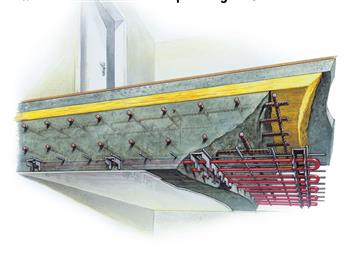 Mit dem Ziel der weiteren Reduzierung des Energiebedarfs und der CO2-Emissionen verlangt die vor gut zwei Jahren verabschiedete EU-Richtlinie 2002/91/EG eine deutliche Steigerung der „Gesamtenergieeffizienz von Gebäuden“. Die Verordnung ist bis zum Januar 2006 von allen Mitgliedstaaten in nationale Rechtsvorschriften umzusetzen, die das Gebäude als ein energetisches Gesamtsystem betrachten. Das erfordert neue Konzepte für Heizen und Kühlen. Das ClimaCool CCW-System von Wavin RCS ermöglicht Architekten und Bauherrn dabei schon heute eine ebenso innovative wie ganzheitliche Lösung zur behaglichen Deckenheizung und kühlung bei minimiertem Energieverbrauch und reduzierten Anlagenkosten.